
How to read tarot for yourself should not feel like decoding a secret language. Many beginners are drawn to tarot with curiosity and openness, only to feel overwhelmed by long guidebooks, rigid interpretations, and the pressure to memorise every card. What begins as a soulful practice can quickly start to feel complicated.
The truth is that tarot does not need to be overwhelming.
At its heart, tarot is a reflective tool. It helps you pause, listen, notice patterns, and bring your inner world into clearer view. Learning how to read tarot for yourself is not about becoming perfect. It is about building trust in your own response to the cards while gradually learning the structure that supports them.
This guide offers a gentler path. Instead of overcomplicating tarot, it returns to the essentials: choosing a deck you connect with, asking better questions, using simple spreads, and learning to trust your intuition without abandoning tradition. With a calm approach, how to read tarot for yourself becomes less about getting it right and more about reading with clarity, honesty, and care.
Table of Contents
How to Read Tarot for Yourself by Creating a Simple Practice
One of the best ways to begin learning how to read tarot for yourself is to create a practice that feels simple, welcoming, and personal. You do not need an elaborate altar or a deep academic knowledge of tarot to start. You need a quiet moment, a little curiosity, and a willingness to be present.
Choose a tarot deck that feels right
Your first deck does not have to be the most traditional. It does not have to be the one everyone recommends. It simply needs to feel visually alive to you.
Look at the artwork and notice your response. Do the images feel inviting, mysterious, comforting, or emotionally resonant? Tarot is a symbolic language, and your connection to the imagery matters. When you feel drawn to a deck, it becomes easier to trust your own impressions and form a genuine relationship with the cards.
Create a calm ritual space
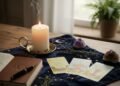
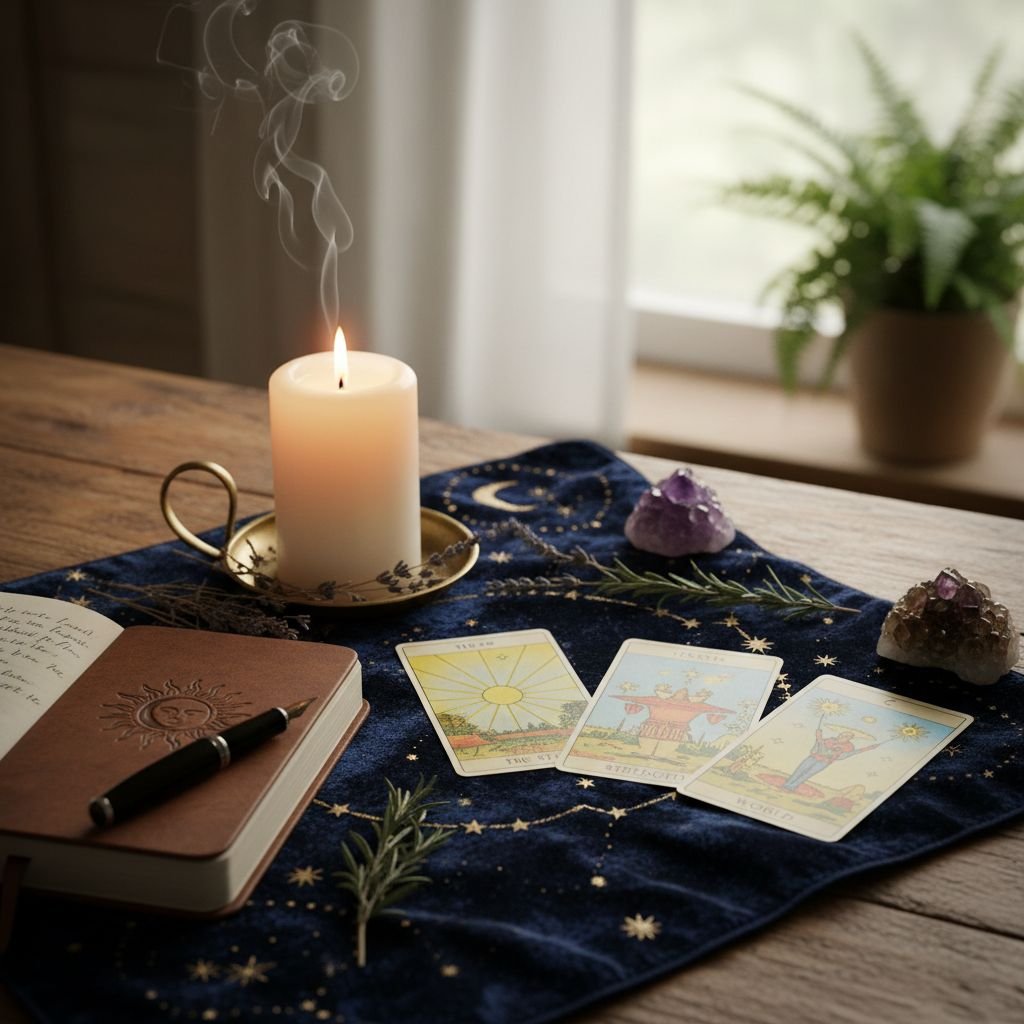
A simple ritual space helps your mind settle before a reading. This could be a small table, a favourite cloth, a journal, a candle, or a cup of tea. The goal is not to create something performative. The goal is to create a pause.
A simple setting tells your body that this is a moment for reflection. It allows you to step out of noise and into presence. Often, the more minimal your space, the easier it is to hear yourself clearly.
Create a sacred space with crystals and ritual tools
Shuffle in a way that centres you
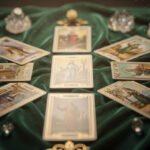
There is no single correct way to shuffle tarot cards. Some people shuffle until a card jumps out. Others cut the deck into piles. Others fan the cards and choose intuitively. All of these are valid.
As you shuffle, breathe slowly and hold your question lightly in your mind. Let the act of shuffling become part of the reading. You are not trying to perform tarot. You are trying to arrive.
How to Read Tarot for Yourself Using Easy Tarot Shortcuts
A lot of beginners feel stuck because tarot seems like too much information at once. One of the easiest ways to simplify how to read tarot for yourself is to learn a few reliable patterns rather than memorising all seventy-eight cards straight away.
Understand the Major Arcana as life lessons
The Major Arcana often point to deeper themes, turning points, or important inner lessons. Rather than seeing them as abstract mystical symbols, try seeing them as reflections of universal human experiences.
The Fool can suggest a beginning, a leap of faith, or a new chapter.
The Hermit may speak to solitude, introspection, or inner guidance.
Death often points to transformation, endings, and renewal rather than anything literal.
When you look at the Major Arcana through the lens of life lessons, the cards become much more approachable.
Use the suits as simple categories
The four suits give you a practical shortcut when learning how to read tarot for yourself:
- Cups relate to feelings, relationships, and intuition
- Wands relate to creativity, energy, action, and desire
- Swords relate to thoughts, stress, clarity, and conflict
- Pentacles relate to work, money, the body, home, and stability
This simple structure helps you orient yourself quickly. A reading full of Cups may be asking you to pay attention to emotions. A reading heavy with Pentacles may be focused on practical matters. A spread full of Swords may point to tension, overthinking, or the need for clarity.
Notice repeating symbols and patterns
You do not have to interpret every detail at once. Start by noticing what repeats. Are there mountains, water, flowers, doors, animals, or strong body language? Are multiple cards pointing toward movement, stillness, tension, or openness?
Tarot often becomes clearer when you stop chasing perfect meanings and start noticing patterns.
How to Read Tarot for Yourself with Better Questions
A powerful reading often begins with a powerful question. When learning how to read tarot for yourself, this matters just as much as understanding the cards.
Move away from prediction
Tarot tends to be more useful when it offers guidance rather than fixed prediction. Questions like Will this happen? can leave you waiting for certainty. Questions like What do I need to understand about this situation? create space for insight and choice.
Instead of asking:
- Will I get the job?
Try asking:
- How can I prepare well for this opportunity?
Instead of asking:
- Does this person love me?
Try asking:
- What do I need to see clearly about this relationship?
Tarot works beautifully as a mirror. It helps you notice what is already present and what may need your attention.
Ask clear, focused questions
A strong tarot question is:
- clear
- centred on one topic
- open to guidance
- grounded in your own next step
Questions beginning with what, how, and where often work well.
Examples include:
- What am I not seeing clearly right now?
- How can I support myself during this change?
- Where is my energy best placed this week?
Follow the one-topic rule
A common beginner mistake is asking about everything at once. Love, work, money, family, purpose, and healing all rolled into one spread can lead to confusion.
Keep it to one topic at a time. Clearer questions usually lead to clearer answers. This is one of the simplest but most effective ways to improve how to read tarot for yourself.
How to Read Tarot for Yourself with Simple Tarot Spreads
You do not need a complicated ten-card layout to receive meaningful guidance. In fact, the simpler the spread, the easier it is to build confidence.
The one-card daily pull
The one-card pull is one of the most powerful ways to learn how to read tarot for yourself. It is simple, sustainable, and excellent for building intuitive trust.
Ask:
- What energy is with me today?
- What wants my attention today?
- What can support me today?
Draw one card and spend time with it before opening a guidebook. Notice the colours, posture, atmosphere, and symbols. Write down your first impressions in a journal. Over time, this helps you understand how cards speak to you personally.
[Internal link: Pair your practice with a journal or reflective ritual]
The past-present-future spread
A classic three-card spread offers quick context and clarity:
- Past
- Present
- Future
You can also adapt it to:
- Situation
- Challenge
- Guidance
Or:
- What to release
- What to embrace
- What to trust
This kind of spread gives structure without overwhelm. It is one of the most helpful tools for beginners who are still learning how cards relate to each other in a reading.
How to Read Tarot for Yourself with More Intuitive Confidence
One of the biggest shifts in tarot happens when you stop relying on outside meaning for every card and start trusting your own first response.
Notice your first reaction before checking the guidebook
Before reaching for the booklet, pause and ask yourself:
What do I feel when I look at this card?
Does it feel calm, tense, hopeful, guarded, open, or heavy? Which symbol stands out first? What emotion does the card create in you?
Your first response matters. Tarot is visual and symbolic by nature. Often, the meaning begins with what the image awakens in you.
Use the guidebook as support, not authority
Guidebooks can be useful, especially in the beginning. But try using them after you have made your own notes. This allows your intuition to speak first.
Over time, you may notice that the guidebook often confirms what you already sensed. That is how confidence grows. The aim is not to reject traditional meaning, but to let it support your inner reading rather than replace it.
Allow personal symbolism to deepen the reading
A bird, doorway, moon, mountain, or river may carry a personal meaning for you. These associations are valuable. Traditional tarot meanings provide structure, but your lived experience adds depth and feeling.
Learning how to read tarot for yourself becomes more natural when you allow both tradition and personal symbolism to work together.
How to Read Tarot for Yourself Without Bias
Reading for yourself can be beautiful, but it also requires honesty. When you are emotionally involved in the topic, it can be easy to see only what you hope to see or fear the worst.
Watch for wishful thinking
When a card seems to confirm exactly what you wanted, pause for a moment. Ask whether you are reading the message clearly or selecting only the parts that feel comforting.
A positive card does not always mean an easy outcome. The Sun may reveal truth, but truth can still be uncomfortable. The Lovers may point to alignment, but it can also point to a meaningful choice.
Try to stay with the fuller message.
Do not panic over difficult cards
Beginners often feel worried when cards like Death, The Tower, or the Ten of Swords appear. Yet these cards are rarely as frightening as they seem at first glance.
Tarot is symbolic. Death often points to transformation. The Tower can indicate necessary change, release, or sudden clarity. The Ten of Swords may mark exhaustion, but also the end of a painful cycle.
Hard cards are not punishments. They are invitations to honesty.
Step away and return if needed
If you feel too emotionally activated to read clearly, it is completely fine to pause. Put the cards down, make a cup of tea, go for a walk, or return the next day. Sometimes clarity comes more easily when there is a little space between you and the question.
Final Thoughts on How to Read Tarot for Yourself
Learning how to read tarot for yourself does not require perfect memory, complicated rituals, or total certainty. It begins with attention, curiosity, and trust. It begins with choosing a deck that feels right, asking questions that open insight, using simple spreads, and allowing your own inner response to matter.
The more gently you approach the cards, the more naturally the practice unfolds.
You do not need to force tarot to speak. You only need to slow down enough to listen.
That is where confidence grows. That is where symbolism becomes personal. And that is where how to read tarot for yourself shifts from something intimidating into something meaningful, grounded, and quietly powerful.
If you’d like to go deeper, join us on the Awen Life YouTube channel for calm, grounding guidance — seasonal rituals, gentle practices and quiet reflections to help you return to yourself: https://www.youtube.com/@AwenLife